

Example buying path
What must travel with the customer?
Choose a surface, then test what happens when the underlying product information disagrees.
Social
A video answers a question about high-heat cooking.
- The handoff
- A clear product fact and caption give the viewer a useful next question.
- Useful next step
- Keep the supporting information accurate and review how this surface presents it.
- What measurement can tell you
- Native platform engagement is a partial signal, not proof of a later purchase.
This explanation changes locally. It does not query Google, an assistant, analytics or a customer account.
If you work in organic marketing, 2026 has probably brought two opposite claims to your inbox. One says SEO is over because AI answers have replaced clicking. The other says nothing has changed and you should keep doing what you’ve always done.
Neither is useful. The better question is narrower: what has Google actually documented about search in 2026, and what does that mean for SEO’s job inside a broader organic growth strategy?
This article answers that in two clearly separated parts. First, what Google’s own documentation says, with sources. Then our perspective at Organicaly: a model for how SEO connects to content, AI visibility, product feeds, social and community, plus a fictional buying path that shows the handoffs in practice.
The short answer
- Google’s documentation says the fundamentals still apply. There are no additional requirements to appear in AI Overviews or AI Mode. A page needs to be indexed and eligible to show in Search with a snippet.
- SEO’s role has widened, not shrunk. In our view, SEO is now the foundation and the research function for organic growth as a whole. It makes your best information reachable, consistent and understandable, and it tells the other channels what people actually want to know.
- The work that matters most sits in the handoffs. These are the points where search research turns into content, product data turns into feeds, and community questions turn into pages. Plan SEO in isolation and those handoffs go unowned.
1. What Google has documented
This guidance concerns Google Search, including AI Overviews and AI Mode. It does not describe eligibility or measurement for every independent AI assistant.
These are statements from Google Search Central documentation, linked below. Where we paraphrase, the meaning stays with the source.
AI features in Search
- No additional requirements. Google’s page on AI features states there are no additional requirements to appear in AI Overviews or AI Mode, and no special optimisations are needed beyond existing SEO best practices. (AI features and your website)
- Eligibility is the same as for Search snippets. To be eligible as a supporting link, a page must be indexed and eligible to appear in Google Search with a snippet. Google adds that this doesn’t guarantee it will be shown. (AI features and your website)
- No new files or special markup. Google says you don’t need new machine-readable files, AI text files, special markup or special schema.org structured data to appear in these features. (AI features and your website)
- Query fan-out. Google describes AI Overviews and AI Mode as potentially running multiple related searches across subtopics (“query fan-out”), which can surface a wider and more diverse set of supporting links than a single classic search. (AI features and your website)
- Reporting. Traffic from these features is included in Search Console’s Performance report under the “Web” search type. It is not reported as a separate channel. Google also says it has seen that clicks from search results pages with AI Overviews are higher quality, which it defines as users being more likely to spend more time on the site. That is Google’s observation, and you should check it against your own analytics. (AI features and your website)
- Controls. Site owners can limit what’s shown with
nosnippet,data-nosnippet,max-snippetornoindex, and control Googlebot’s access with robots.txt. (AI features and your website) - Practices Google calls out. These include allowing crawling, including through any CDN or hosting layer; making content easy to find through internal links; providing a good page experience; keeping important content in text form; supporting text with high-quality images and video; making structured data match the visible text; and keeping Merchant Center and Business Profile information up to date. (AI features and your website)
Content quality and AI-assisted content
- People-first content. Google’s systems aim to prioritise helpful, reliable content created for people rather than to manipulate rankings. Google calls trust the most important part of E-E-A-T, and it encourages being clear about who created content, how it was created, and why. (Creating helpful, reliable, people-first content)
- Generative AI is allowed, but scaled low-value content isn’t. Using generative AI to produce many pages without adding value for users may violate Google’s spam policy on scaled content abuse. Google advises fact-checking AI-generated content before publishing, including titles, meta descriptions, structured data and alt text. (Using generative AI content; Spam policies)
Product data and site structure
- Two ways to share product data, used together. Google recommends both structured data on product pages and Merchant Center feeds. Structured data helps Google understand pages, while Merchant Center gives more control over product data. (Share your product data with Google)
- Links still map the site. Google uses links between pages, rather than URL structure, as its main way to understand a site’s structure. It recommends crawlable
<a href>links so important pages are reachable by browsing. (Help Google understand your ecommerce site structure) - Patience. Google’s starter guide notes that some changes take effect within hours while others take months, and it suggests waiting a few weeks before judging whether a change helped. (SEO Starter Guide)
That is the documented ground. Everything below is our interpretation. It is a strategy, not a statement from Google.
2. Our perspective: SEO’s job has widened
Read Google’s guidance as a whole and a pattern emerges. The things that make a page eligible for AI features are the same things that make it eligible for classic search: crawlable, indexed, clearly written, consistent with its structured data, and backed by accurate product information. For these Google Search features, the documentation does not prescribe a separate technical layer. Other assistants have different systems and should be assessed on their own evidence.
What has changed, in our view, is how many places a customer meets your information before deciding. A shopper might see you first in a social feed, compare options in an AI answer, read opinions in a community thread, and check prices in a shopping result before visiting your site. Many of those surfaces draw on the same underlying facts: your pages, your product data, and what other people say about you.
That gives SEO two jobs in 2026:
- The foundation. Make sure the information that matters is reachable, indexable, consistent and understandable, whichever surface ends up showing it.
- The research function. Search data is still one of the clearest records of what people want to know in their own words. That research should feed content, product data, social and community, not only title tags.
3. The connected organic growth model
We plan organic growth in four layers. SEO runs through all of them, but it doesn’t own every one.
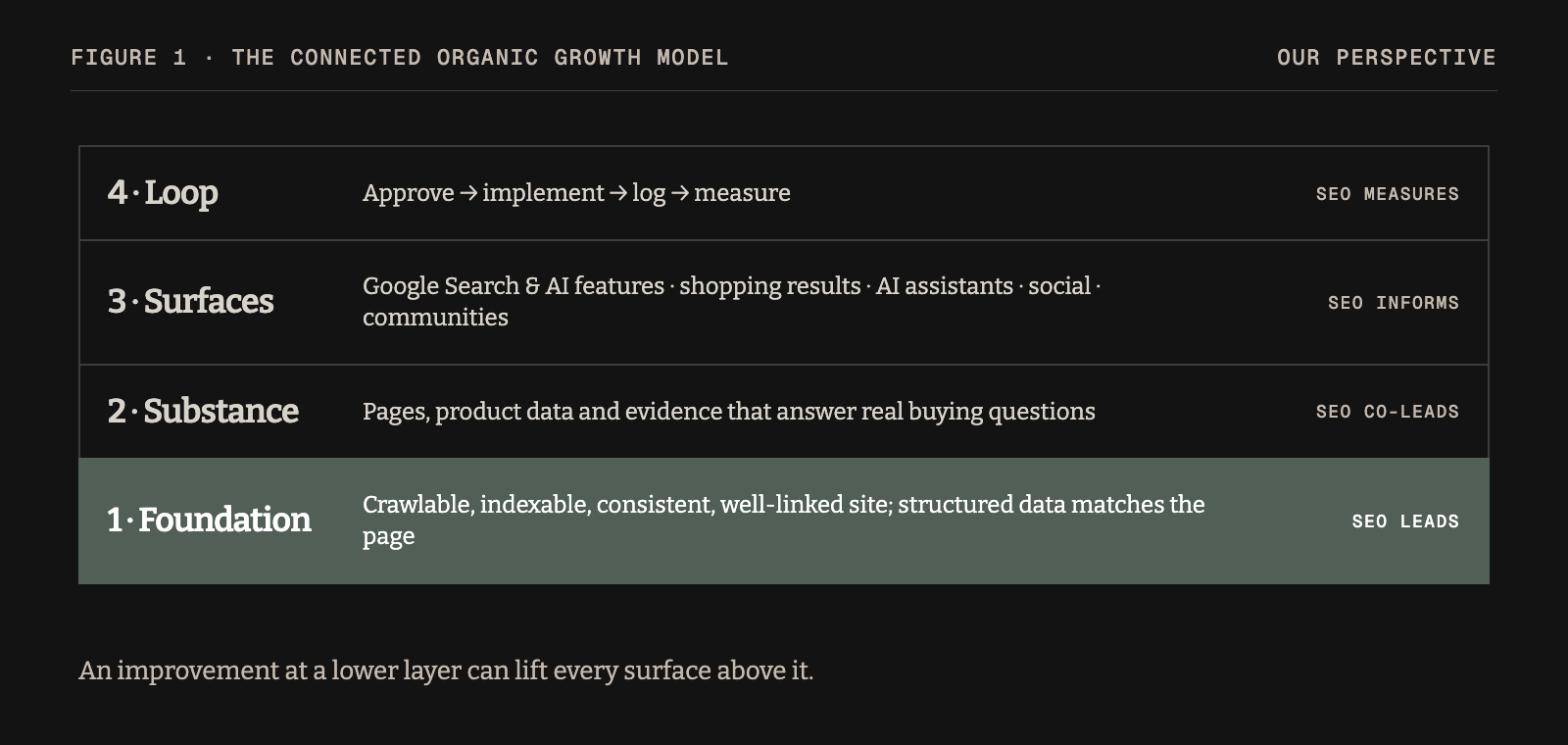
| Layer | What it is | Who usually leads | SEO’s role |
|---|---|---|---|
| 1. Foundation | Crawlable, indexable, fast, well-linked site, with structured data that matches the page | SEO / development | Leads |
| 2. Substance | The pages, product data and evidence that answer real buying questions | Content, merchandising, subject experts | Co-leads: supplies demand research and page structure |
| 3. Surfaces | Where people meet you: Google Search and its AI features, shopping results, AI assistants, social platforms, communities | Varies by surface | Informs: keeps facts consistent and provides the pages that surfaces link to |
| 4. Loop | Review where required → implement → log → measure | Whoever owns the programme | Measures: Search Console and analytics provide much of the evidence |
The point of the model isn’t the boxes. It’s the reminder that an improvement at a lower layer can lift every surface above it. One fix to inconsistent product attributes, for example, can improve the product page, the feed, the structured data and the information an AI system can draw on.
4. The handoffs: where SEO gives and gets back
Most organic programmes are organised by channel. The problems usually sit between channels. This table is the working checklist we use to find them.
| Handoff | SEO gives | SEO gets back | What breaks when it’s unowned |
|---|---|---|---|
| SEO → Content | Demand research: the questions, comparisons and terms people use, grouped by intent | Pages with genuine expertise that deserve to rank and be cited | Content is written for keywords nobody needed, or experts write without knowing what readers search for |
| SEO → AI visibility | Indexable, snippet-eligible pages with key facts in plain text, plus structured data that matches the page | Observations of how AI answers describe the category and the brand, which show where information is missing or unclear | The brand tries to “optimise for AI” with special files or tricks Google says aren’t needed, while basic facts stay buried |
| SEO → Catalog and product feeds | Product attributes and naming informed by how people search, with structured data on product pages | Feed diagnostics that expose missing or conflicting product data | Price, availability or attributes disagree between page, markup and feed |
| SEO → Social | The language and questions people search for, which become hooks and topics | Early signals of new questions and phrasing before they show up in keyword tools | Social and search describe the same product in different words and neither benefits |
| SEO → Community | Strong pages that community answers can point to | The real questions, objections and comparisons customers raise in their own words | Recurring community questions never become pages, so the brand keeps re-answering the same thing |
5. A buying path in practice (illustrative, fictional)
This example is fictional. “Larchmere” is an invented cookware brand and “Priya” is an invented shopper. The steps illustrate how the handoffs work and don’t describe a real customer, client or dataset.
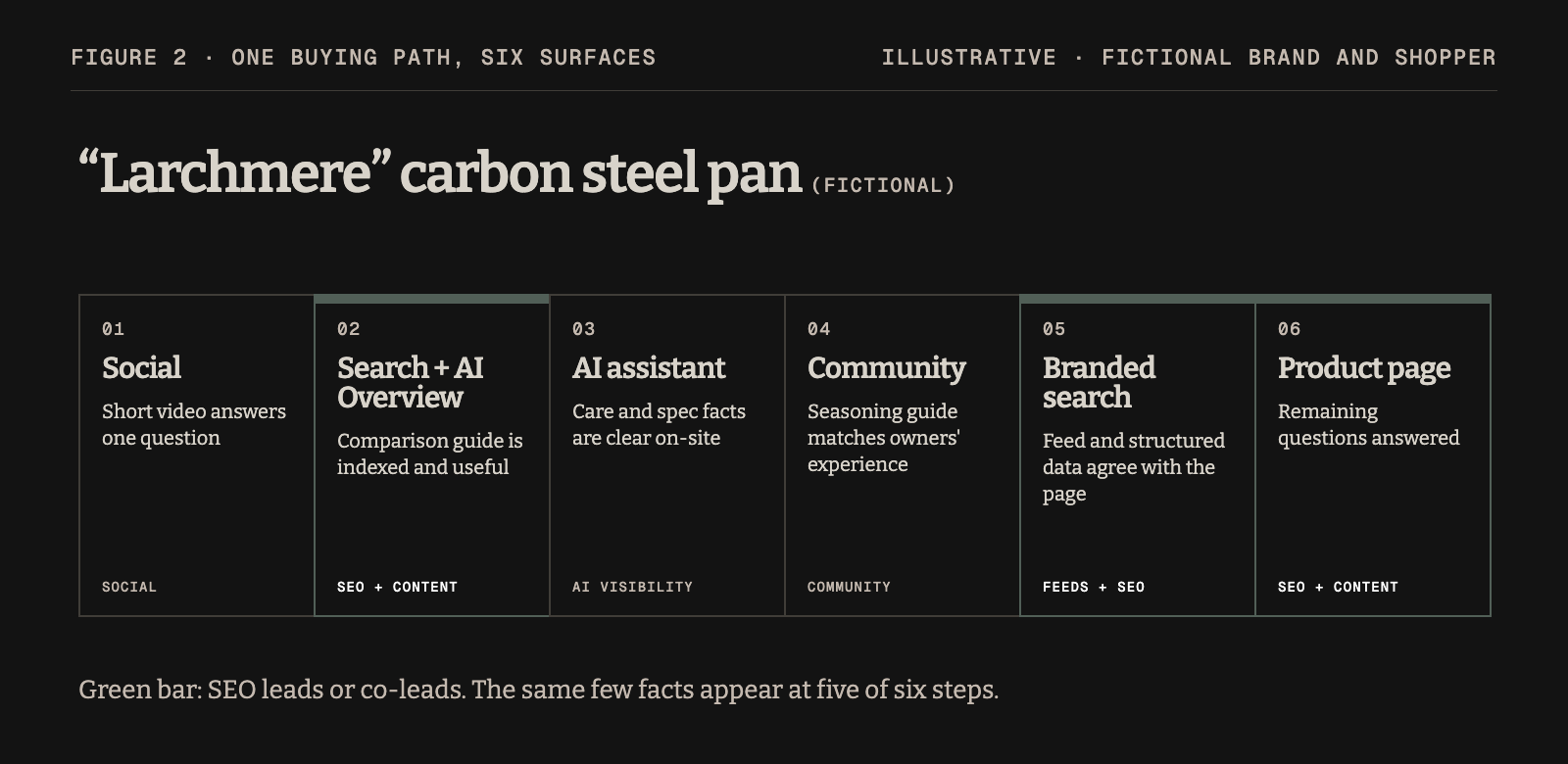
Priya wants a pan that can handle high heat. Here is her path, and what had to be true at each step for Larchmere to stay in consideration.
| Step | What Priya does | Channel that leads | What had to be true |
|---|---|---|---|
| 1 | Sees a short video about searing on carbon steel | Social | The video answered one clear question, and the caption used the words people search for |
| 2 | Searches “carbon steel vs cast iron pan” and reads an AI Overview with supporting links | SEO + Content | Larchmere’s comparison guide was indexed, snippet-eligible and genuinely useful, with the key differences stated in plain text |
| 3 | Asks an AI assistant which carbon steel pans are easiest to maintain | AI visibility | Larchmere’s care instructions and product specifications were clear, consistent and easy to find on its own site |
| 4 | Reads a community thread where owners discuss seasoning | Community | Larchmere’s seasoning guide matched what owners actually experience, so people were comfortable linking to it |
| 5 | Searches “Larchmere carbon steel pan” and sees a product result with price and availability | Catalog and feeds + SEO | Merchant Center data and on-page structured data agreed with the visible price and stock |
| 6 | Lands on the product page and buys | SEO + Content | The page answered the remaining questions (weight, induction compatibility, care) without making her hunt |
What the example shows:
- SEO played a direct part in three of the six steps (2, 5 and 6), but each depended on work done elsewhere.
- The same few facts (what the pan is made of, how to care for it, what it costs, whether it’s in stock) appeared in five different places. If any one disagreed with the others, the path could have broken.
- No single channel report reconstructs this fictional path. Search Console may provide aggregate impressions and clicks relevant to the search steps, subject to its reporting limits; it does not identify this shopper or join the journey together. Social and site analytics have their own coverage and consent limits. Assistant and community interactions may be unobserved. These signals do not prove which touchpoint caused a purchase.
6. How to prioritise SEO work in 2026
Here’s a practical order of operations that follows from Google’s documentation and the model above.
1. Protect eligibility first.
- Confirm important pages are crawlable, including through your CDN or hosting layer, and indexed.
- Check that you aren’t accidentally limiting snippets on pages you want shown (
nosnippet,max-snippet,noindex). - Make sure important pages are reachable through crawlable links, not only through on-site search or script-driven navigation.
2. Make the facts consistent.
- List the 10–20 facts that most influence a purchase in your category, such as materials, sizing, compatibility, price, availability and returns.
- Check that each one is stated the same way on the page, in structured data, in your product feed and in your help content.
3. Put substance where demand is.
- Group search demand by buying intent, not by individual keyword.
- For each group, decide which page type should answer it (category, product, guide or comparison) and whether that page currently does.
- Write with genuine expertise. Google’s guidance on helpful content and on generative AI points in the same direction: originality, accuracy and human oversight.
4. Close the handoffs.
- Create a shared list of recurring customer questions from search, community, social and support, and assign each one a page that answers it.
- Route feed diagnostics back to whoever owns product content.
5. Measure changes, not moods.
- Log each change with its go-live date.
- Compare an appropriate before-and-after window for the pages affected. Record promotions, seasonality, demand changes, other work and tracking changes; an association is not proof of a causal effect.
- Remember that AI feature traffic sits inside Search Console’s “Web” search type, so look at page-level trends rather than hunting for a separate AI channel.
7. Common mistakes we expect to see this year
- Treating Google Search guidance as a rule for every AI system. For Google AI Overviews and AI Mode, Google’s documentation says no special files or markup are needed. Start with the fundamentals and the consistency of your facts.
- Measuring AI visibility as if it were revenue. Being mentioned or linked in an AI answer is a visibility signal. Treat it as one input, keep it separate from observed outcomes, and don’t model revenue from it without saying so.
- Scaling thin pages because generation is cheap. Google’s spam policies target scaled content made mainly to manipulate rankings, however it was made.
- Letting channels contradict each other. If your page, structured data, feed and social captions disagree, you’ve created the confusion yourself.
- Judging changes too quickly. Google notes some changes take months to show. Decide your evaluation window before you ship.
8. A one-page checklist
- Key pages crawlable (including at CDN/host level) and indexed
- No unintended snippet restrictions on pages you want shown
- Important pages reachable through crawlable
<a href>links - Top purchase-deciding facts consistent across page, structured data, feed and help content
- Structured data matches visible text
- Merchant Center and Business Profile information current, where relevant
- Search demand grouped by intent and mapped to page types
- Shared customer-question list owned and mapped to pages
- Change log with go-live dates
- Evaluation windows agreed before changes ship
Where SEO fits
SEO in 2026 isn’t a channel competing with AI, social and community for budget. It’s the foundation they stand on and the research that tells them what to say. Google’s documentation makes the foundation clear. The connection to everything else is a strategic choice, and that choice is what turns separate optimisations into organic growth.
Sources: Google Search Central documentation as linked throughout, linked for verification. The connected organic growth model, handoff table and buying path are Organicaly’s own perspective and illustration.
Explore the local drafts Introducing Organicaly and Ecommerce SEO strategy for the service context and a practical worksheet.